Cellular (honeycomb) shades and conventional blinds differ markedly in insulation, sound control, light management, aesthetics, installation, maintenance, safety, cost, and environmental impact. This report rigorously compares their material/construction, thermal R‑value and energy savings, sound insulation (dB reduction), light control/privacy, design options, window compatibility, cleaning/durability, child-pet safety (corded vs cordless, standards), cost (purchase, installation, lifetime). It also reviews market trends and usage scenarios (bedroom, living room, office, rentals, climate zones). Findings show cellular shades trap air in honeycomb cells to offer superior thermal insulation and energy savings, while also providing uniform blackout/privacy; they have a sleek, modern look and suit spaces where energy efficiency and quiet are priorities. Blinds (slatted window coverings) excel at adjustable daylight and airflow, are typically less expensive upfront, and install easily. Each has pros/cons: blinds are better for ventilation and view management, whereas cellular shades save heating/cooling costs and reduce noise. Ultimately, the best choice depends on room function and climate, and often a combination of both yields the optimal solution.
Table of Contents
- 1. Definitions and Types
- 2. Materials & Construction
- 3. Thermal Insulation
- 4. Sound Insulation
- 5. Light Control & Privacy
- 6. Aesthetics & Design Options
- 7. Installation & Compatibility
- 8. Cleaning & Durability
- 9. Child & Pet Safety
- 10. Cost Comparison
- 11. Market Trends & Preferences
- 12. Pros & Cons Decision Matrix
Definitions and Types:
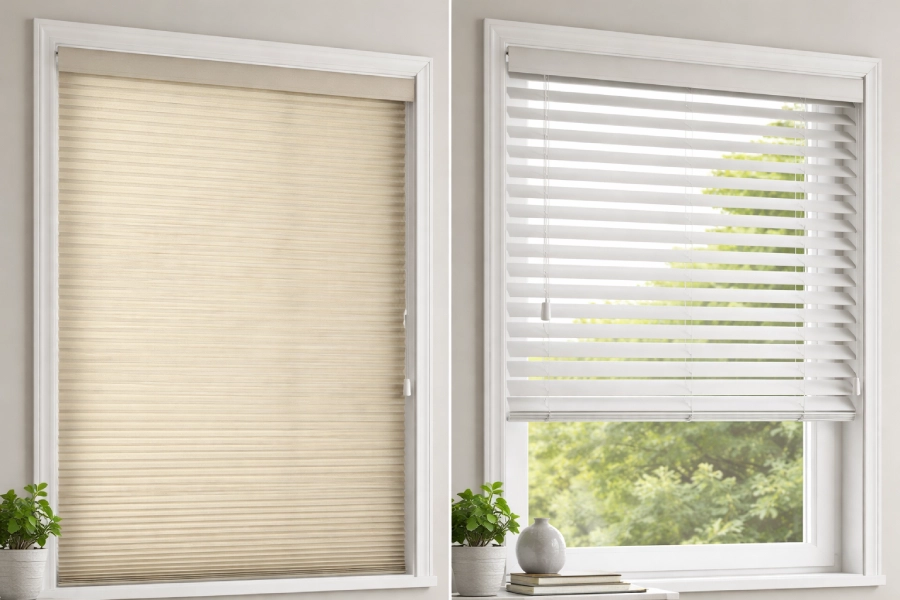
Cellular shades (also called honeycomb shades) consist of one or more layers of pleated fabric cells that expand and collapse like an accordion. Their defining feature is the hexagonal, air-trapping honeycomb structure, giving them superior insulation and light-blocking abilities. Cellular shades typically come in single-cell or double-cell varieties, and often feature soft, fabric material. In contrast, blinds are made of multiple pivoting slats of material (metal, wood, or plastic) mounted horizontally or vertically. The key difference is function: cellular shades prioritize thermal insulation and room darkening, whereas blinds prioritize controllable light entry and airflow. Both are window treatments but fall into different categories of window coverings.
Materials & Construction:
Cellular shades are made from various fabrics and composites. Common materials include polyester (for strength and UV resistance), non-woven fabrics (for breathability and dust filtration), natural fibers (cotton, linen for softness), paper-based layers (for low cost), and even metalized or aluminum-coated fabric. For example, polyester cellular shades are durable and easy to clean, while non-woven cellular shades are eco-friendly and provide good sound dampening. Paper or recycled polyester layers are used for budget-friendly shades (but wear out faster). Some designs incorporate thin aluminum or foil layers inside the cells for enhanced insulation. Importantly, cellular shades are built from pleated honeycomb cells (single or double layers) that trap air as insulating pockets.
By contrast, standard blinds are built from rigid slats and supporting rails. Common blind slat materials include aluminum (lightweight, moisture-resistant, but easily dented ), wood or bamboo (warm appearance, sturdy, expensive), and PVC/wood-composite (water-resistant and dent-resistant, but prone to yellowing/brittleness). The slats are typically 25-50mm wide and mounted on headrails, with cords, rods or wands to tilt the slats. In summary, cellular shades rely on fabric pleats and air cells, while blinds use solid slats and mechanical assemblies.
Thermal Insulation:
Cellular shades excel at insulation. The U.S. Department of Energy notes insulated cellular shades “are typically considered to have the highest R-values of all window coverings.” The trapped air in the honeycomb cells acts as an insulator. Lab studies show that properly-fitted cellular shades can reduce heat loss through windows by ~40% in winter (about 10% heating energy savings) and can cut up to 60% of solar heat gain in summer. By contrast, louvered blinds (with many gaps) have much lower effective insulation. While closed blinds can reflect sunlight and diffuse light, they cannot prevent heat transfer as effectively. In short, honeycomb shades dramatically improve window R‑value, whereas blinds offer minimal R‑value improvement. Double-cell (two-layer) cellular shades provide even greater insulation than single-cell designs.
Sound Insulation:
Cellular shades inherently damp sound due to their multiple air-trapping layers. Industry guides note double-cell shades offer about twice the noise reduction of single-cell shades. In practice, users report that pairing cellular shades with heavy drapes can further cut room noise by ~10–15 dB versus one layer of curtain. In sum, cellular shades provide moderate sound absorption—helpful for quieter rooms—though they are not a substitute for full soundproofing. Blinds, with rigid slats and gaps, offer very limited sound insulation. So while blinds do not significantly reduce noise, a cellular shade (especially double-cell) does help muffle ambient sound.
Light Control & Privacy:
Blinds and cellular shades offer different light-management options. Blinds let you tilt slats to softly filter daylight and block direct views , enabling ventilation while controlling privacy. In contrast, cellular shades use continuous fabric panels. They come in light-filtering or blackout fabrics (even “day/night” two-layer designs) for flexible light control. As one source notes, cellular shades “filter natural light to reduce glare without completely blocking sunlight”. In general, cellular shades provide very even light-blocking across the window, while blinds allow partial view-out between slats. For privacy, both block sight-lines when fully lowered, but cellular shades are opaque (no gaps) when closed. For example, fully-closed blackout cellular shades can block ~99% of light, ideal for bedrooms, whereas translucent cellular shades softly diffuse light.
Aesthetics & Design Options:
Both shade types offer wide style ranges. Cellular shades are known for their sleek, minimalist look with neutral fabric options. As one decor guide notes, their “chic, simple design and neutral color selections” fit nearly any decor style. When fully raised, cellular shades create a very small stack (literally disappearing into the window frame) , which many find visually clean. Blinds present a more tiered appearance: wood blinds bring warmth and texture, aluminum blinds impart a crisp, modern feel, and horizontal slats cast linear patterns when sunlight falls. Both have fabrics/finishes from light-filtering sheer to room-darkening blackout. Designers often mix and match: e.g., day/night cellular shades combine light-filtering and blackout fabrics for elegant versatility. In summary, cellular shades lean toward modern/minimal styles, whereas blinds (especially wood blinds) can suit classic or rustic decors.
Installation & Compatibility:
Both cellular shades and blinds can be mounted inside or outside the window frame. Cellular shades have the advantage of a very thin stack, making inside mounts possible even in shallow frames. In fact, they often require only ~5/8"–7/8" depth, so they fit in most window pockets. Blinds generally need more clearance for the headrail and lift mechanism, so very shallow windows may require outside-mount brackets. For outward-opening windows, cellular shades mounted inside do not interfere with the window, whereas blinds might need special clearance. In practice, cellular shades work on almost all window types (hung, casement, sliding), while blinds fit best in deep-set or fixed-frame windows. Both can be inside-mounted or have a decorative valance. Note: blinds often require a larger frame depth to allow the horizontal slats to tilt freely; cellular shades do not.
Cleaning & Durability:
Cellular shades can be tricky to clean because dust gets trapped in the pleats. Owners usually vacuum them gently or use compressed air. They should not be crushed by heavy objects, or the shape will deform. However, a benefit is that they are one continuous fabric panel, so washable models can be machine-washed or wiped as a whole. Blinds, on the other hand, have flat slats that you can easily wipe or dust one by one. The trade-off is there are many slats (large surface area), so cleaning takes time. Cellular shades are built to resist wrinkles and fading, which implies durability. Blinds' weakest parts are the pull cords and tilt mechanisms, which often wear out in ~5-7 years. A minor ding can dent a thin aluminum blind slat irreversibly. In practice, a well-made cellular shade can last many years without replacement. High-end cellular fabrics resist sun damage. Blinds also last long but may need occasional repairs (cords, slats) over time.
Child & Pet Safety:
Hanging cords pose a strangulation hazard. Experts warn that “wherever cords are present, there is a risk of entanglement or accidental playing”. Indeed, cord loops are a well-known risk factor in homes with toddlers and curious pets. In response, many regions now require cordless or cord-locking mechanisms on new window treatments. Both cellular shades and blinds are available in cordless versions: options include spring-loaded rollers, tensioned wand systems, and motorized controls. For example, cellular shades can use a cordless spring-lift or a motor to raise/lower the shade. These designs eliminate dangling cords entirely. In short, for any windows accessible to children or pets, a cordless shade or one with approved safety devices is strongly recommended.
Cost Comparison:
| Cost Item | Cellular Shades | Blinds |
|---|---|---|
| Initial Purchase Cost | Higher (approx. $300–$600 per set) | Lower ($50–$150, aluminum blinds) |
| Installation Cost | Moderate (simple installation) | Moderate (requires mounting brackets) |
| Energy Cost | Reduces heating/cooling costs (energy-saving) | No significant energy-saving effect |
| Maintenance / Replacement Cost | Low (durable fabric, less prone to damage) | Depends on usage, may require frequent minor repairs |
| Overall Cost Performance | High (long-term energy savings + durability) | Lower (cheaper upfront but higher energy costs) |
Note: Prices are for reference only. Actual costs may vary depending on brand, size, customization, and regional market conditions.
Cellular shades usually cost more upfront than basic blinds. For example, one report notes a cellular shade set costs ~$200–$400 more than a standard roller shade. However, those extra dollars often pay back within a few years via lower heating/cooling bills. In practice, budget aluminum blinds can be bought for a fraction of the price (e.g. $50–$150 per blind) versus custom cellular shades (often $300+ per shade). Installation costs are similar for both. Maintenance costs: a cellular shade (with durable fabric) rarely needs replacing, while blinds might need periodic cord or slat fixes. Long-term, cellular shades offer lower lifetime cost due to energy savings and durability.
Market Trends & Preferences:
The global cellular shades market is growing steadily (estimated US$12.8B in 2023 to $18.8B by 2032, ~4.4% CAGR). Demand drivers include energy efficiency concerns and smart-home interest. Buyers are looking for window treatments that improve insulation, light control, aesthetics and support automation. In China, younger homeowners increasingly choose sleek honeycomb shades over bulky blinds for modern decor (one source notes honeycomb shade prices are comparable to fabric curtains and cheaper than high-end blinds). However, budget buyers still often opt for cheaper roller or Venetian blinds, which limits cellular-shade market share. In North America and Europe, cellular shades are now mainstream; Asia-Pacific is catching up. Major brands include Hunter Douglas, 3 Day Blinds, Bali (North America), and TOSO, Alena (Asia). When purchasing, consumers weigh energy savings, privacy, style, and safety (e.g. cordless/electric operation).
Pros & Cons Decision Matrix:
| Feature | Cellular Shades | Blinds |
|---|---|---|
| Insulation | ✔ High R-value, excellent energy efficiency | ✖ Gaps between slats, moderate insulation |
| Sound Absorption | ✔ Good sound absorption (better with double-cell) | ✖ Poor sound insulation |
| Light Control | ✔ Options for light filtering or blackout, multiple modes (day & night) | ✔ Precise control of light angle |
| Privacy / Blackout | ✔ Fabric-based, seamless light blocking | ✖ Light leakage through slat gaps |
| Airflow | ✖ Blocks airflow | ✔ Adjustable airflow via slats |
| Aesthetics | ✔ Modern, minimal design with compact stack | ✔ Diverse materials, strong decorative appeal |
| Installation Flexibility | ✔ Compact stack, suitable for inside mount | ✖ Requires deeper window frame; outward-opening windows need extra setup |
| Cleaning | ✖ Difficult to clean pleated structure | ✔ Slats can be wiped, but numerous |
| Durability | ✔ Durable material, resistant to deformation | ✖ More mechanical parts (cords/slats prone to wear) |
| Safety | ✔ Often available cordless (safer) | ✖ Higher risk due to cords |
| Initial Cost | ✖ Higher (offset by long-term energy savings) | ✔ Lower (more budget-friendly options) |
| Eco-friendliness | ✔ Optional eco-friendly fabrics available | ✖ Depends on material (PVC less eco-friendly, wood better) |
Each shading type has trade-offs. Cellular shades offer the best insulation and privacy but at higher upfront cost. Blinds provide adjustable daylight and cost-savings but less thermal performance. The table above summarizes key attributes. In practice, ask: Does the room need strong insulation and darkness? (if yes, lean cellular) or Is ventilation and budget more critical? (if yes, lean blinds).